Showing posts with label Aim. Show all posts

Monday, 10 May 2010

7: Narrative and Illustration

"The aim of 7: Narrative and Illustration is to help you to approach photography from the point of view of the subject and to show how to tell a story both in a set of pictures and within a single picture. This includes learning the techniques of visual analogy, juxtaposition and certain special effects."

Photography isn't just about capturing attractive images. Sometimes the subject is far more important than composition, balance or colour thus meaning that a photograph for a newspaper or magazine is generally used due to how successful it is at informing us about a person or event. However important the subject is, the image will always be improved if it is skilfully handled.

In photography, a Narrative is the way of telling a story through a set of images. This tends to be easier than trying to sum up a story in a single photograph (Illustration). However, Illustration can have much more impact and ultimately be more memorable.

Sunday, 14 February 2010

6: Artificial Light

"One Aim of 6: Artificial Light is to familiarise you with the special Properties of Artificial Light sources so that you can achieve successful exposures and colour balance. The other is to introduce you to the use of photographic lighting and the idea of controlling light to create particular effects."

Artificial light isn't used as much as Natural Light by amateur photographers as it requires more technical expertise and isn't as readily available. Daylight is easy to use as it needs no preparation, however it only illuminates everything outdoors during day time hours. Knowing how to work with the different types of Artificial Light extends the range of a person's photography as there is virtually no limit to the amount of lighting equipment that can be used.

I'm looking forward to learning how to use the different types of Artificial Light so that I can shoot not only during the day.

Sunday, 27 September 2009

5: Natural Light

"Aim: To show the variety of outdoor light, how to make the best use of it and how to choose appropriate lighting conditions for particular subjects"

Light can be used deliberately to bring texture and atmosphere to a photograph. Without light, it would not be possible to even take photographs and therefore is the most important element of photography. The quality of light can make the all important difference to a picture. It changes significantly and scenes can appear differently every single day. Knowing how to choose or control light is a major step in improving photographs. I am looking forward to learning how to use light to improve my photographs.

Below I have selected twelve photographs from The Textbook that are lit from the four different lighting angles; Front Lit, Back Lit, Side Lit and Rim Lit.

Front Lit:

01. Image 81, Page 151: ‘White Branches’ Ansel Adams

1

02. Image 45, Page 95: ‘Miss Thompson’ Alfred Stieglitz
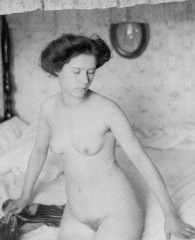
2

03. Image 49, Page 95: ‘Der Malshirm (The Artist’s Umbrela)’ Heinrich Kuehn

3

04. Image 9, Page 21: ‘The Open Door’ William Henry Fox Talbot

4

Back Lit:

05. Image 119, Page 220: ‘El Umbral (The Threshold)’ Manuel Avarez Bravo
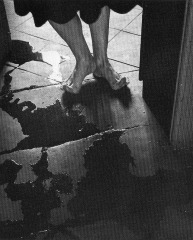
img005

06. Image 39, Page 71: ‘Flither [Limpet] Pickers’ Frank Meadow Sutcliffe
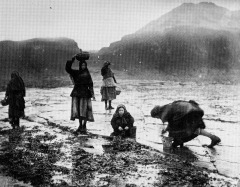
img006

Side Lit:

07. Image 21, Page 39: ‘Portrait Head of a Woman’ Julia Margaret Cameron
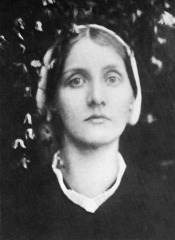
img007

08. Image 40, Page 82: ‘Wilbur Peebo – Comanche’ Edward Curtis

img008

09. Image 44, Page 87: ‘The Pines of Mio’ Herbert G. Ponting, F.R.G.S.
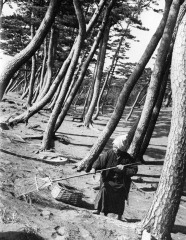
img009

Rim Lit:

10. Image 48, Page 93: ‘Académie’ Robert Demachy
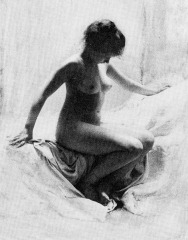
img010

11. Image 107, Page 195: ‘Threshing Corn in Sicily’ Gotthard Schuh

img011

12. Image 35, Page 633: ‘Recruiting Sergeants at Westminster’ John Thomson

img012

Another part of Project 45: Picture Count is to “identify 10 photographs from the textbook in which lighting is of prime importance”. I may be over thinking this slightly but without light then photography wouldn’t exist at all and therefore, I believe light is the most important factor in any photograph! However, I have listed 10 shots below where the specific light condition is the most aesthetic quality.

01. Image 119, Page 220: ‘El Umbral (The Threshold)’ Manuel Avarez Bravo

02. Image 64, Page 117: ‘A Teazel’ Albert Renger-Patzsch

03. Image 84, Page 156: ‘Greene County Georgie’ Jack Delano

04. Image 103, Page 89: ‘A Public Meeting in Estremadura’ David Seymour

05. Image 122, Page 224: ‘Edith. Danville, Virginia 1971’ Emmit Gown

06. Image 35, Page 63: ‘Recruiting Sergeants at Westminster’ John Thomson

07. Image 44, Page 87: ‘The Pines of Mio’ Herbert G. Ponting, F.R.G.S.

08. Image 48, Page 93: ‘Académie’ Robert Demachy

09. Image 114, Page 207: ‘Crosses on Scene of Highway’ Robert Frank

10. Image 115, Page 209: Untitled, William Klein

Friday, 28 August 2009

4: Colour

"Aim: To help understand the basic properties of colour, to learn how to control, alter and modify them in photography and to use them as an element of design"

Colour functions as an element of design in photographs as much as tone or lines but it works in a different way. We all respond to colour uniquely; when used in certain ways it can evoke strong responses, both physically and emotionally. Learning to use colour well gives a photographer much more control over their photographs. Certain colours are associated with specific conditions, orange with warmth, blue with cold, red with passion or danger. I am looking forward to learning more about how to use colour in my photographs and how it can be controlled or manipulated to achieve the best results.

Sunday, 5 July 2009

3: Elements of Design

"Aim: To help understand and use the basic principles of graphic design in photography"

The objective is to be able to identify the graphic elements in any photograph, to asses how important a role they play, and to be able to use them for structure and movement in a composition.

Whilst completing "The Frame", The Golden Section and Balance were touched upon and therefore I have already been introduced to a few elements of design. I am looking forward to learning about more of them and ultimately using them to improve my own photographs.

Monday, 11 May 2009

2: The Frame

"Aim: To help with using the viewfinder as an extension of your eye and to compose well designed and well balanced pictures within it"

At the moment, I tend to see something I like and take a quick photograph. I’m hoping that this set of projects will teach me to take more care when choosing how I capture a subject rather than taking a quick snapshot.